
How to Make AI SaaS for Enterprise in 2026
Introduction:
AI is changing the way businesses run. It isn’t just a tech upgrade; it’s shifting how they compete and talk to their customers. Most companies don’t bother building expensive in-house systems anymore. Instead, they’re leaning on AI SaaS solutions. These tools live in the cloud, giving even a small shop access to heavy-duty tech that used to be out of reach.
It’s cheaper. There are no massive upfront costs, and the setup happens fast. As a result, enterprise-level power is finally accessible to everyone.
A local restaurant might use AI to guess how much milk they’ll need next Tuesday. Hospitals use it to fix messy patient schedules. These AI SaaS solutions help teams hand off the boring, routine work to a machine so they can actually think. Real estate agents use AI software to claw back hours of their day. From dental offices to retail stores, the goal is the same: make things easier and keep the business profitable.
Key takeaways:
Building a great AI SaaS platform takes way more than just a clever machine learning model. You have to stitch together solid cloud infrastructure with data security that won’t leak. It needs a clean interface that people actually enjoy clicking on. And it has to scale. Developers have to bake in business strategies to keep subscription checks coming in every month. It’s a constant balancing act between chasing the latest tech and making sure the whole thing is commercially viable.
This guide breaks down how teams actually build and sell this software. We look at how products go from a cool demo to a tool big companies will pay for. You’ll get into the guts of the tech and the common pricing models that work. We also cover growth strategies. It’s a look at the real steps a business takes when they decide to go all-in on AI-powered tools. Growing a startup is messy, but these are the basics.
- AI SaaS mixes artificial intelligence with software hosted in the cloud. These tools give companies ways to scale that actually work.
- Platforms for big business need secure setups. They rely on APIs and various AI models talking to each other; it’s a tech stack that has to be tightly integrated.
- Subscription fees bring in steady, predictable cash, and that helps keep customers around for the long haul.
- But growth happens fastest when companies tie AI to real, measurable results. It’s about making the workday run smoother. It’s that simple.
What is AI SaaS?
AI SaaS is basically cloud software that uses artificial intelligence to handle the tough stuff. It automates tedious tasks and sorts through massive amounts of data, helping businesses make better decisions. You won’t have to deal with installing complicated hardware or managing servers. Instead, you just sign in through a browser or an app and start working.
This is different from the old software we’re accustomed to. These platforms actually improve over time as they process new data and user input. They’re adaptable, so they can handle changing business needs easily. You’ll see this technology in action with chatbots that manage customer issues or tools that forecast sales for the upcoming month. It’s also used for organizing leads, scheduling medical appointments, and even coordinating marketing efforts. It just simplifies things.
AI SaaS reduces the time it takes for large companies to get set up. It allows teams to scale quickly without needing to hire a ton of extra staff.
Why Businesses Are Investing in AI SaaS:
Businesses don’t buy into AI just because it’s a shiny new toy anymore. They’re spending money because it actually works. It pays off. Here’s how.
Increased Productivity
Autonomous systems kill the grind of manual work. They handle data entry or busywork like scheduling. And they’ll even process your customer invoices.
Better Decision-Making
Companies use Generative AI to chew through massive datasets, often pairing it with predictive analytics. These tools cut work hours down to mere seconds. Conversational AI speeds things up even more.
Lower Operating Costs:
Auto-tools cut down on boring paperwork. It’s better for the budget, too. Now, teams can actually do real work.
Improved Customer Experience
Today’s AI lead agents and assistants answer in a heartbeat. They make every chat feel personal. And they never sleep. New lead agents and smart assistants hit back with instant replies. They make things personal. And these tools never sleep, either.
How AI SaaS Software Is Built:
Building enterprise AI software isn’t about one single tool. It’s a mix of technologies that have to communicate with each other within a secure, scalable setup. If one part fails, the whole thing feels broken.
Most business-grade AI platforms are built around a few main pillars. You’ve got the user dashboard where people actually do the work. Then there’s the API gateway and the AI engine sitting behind the scenes.
Core Architecture:
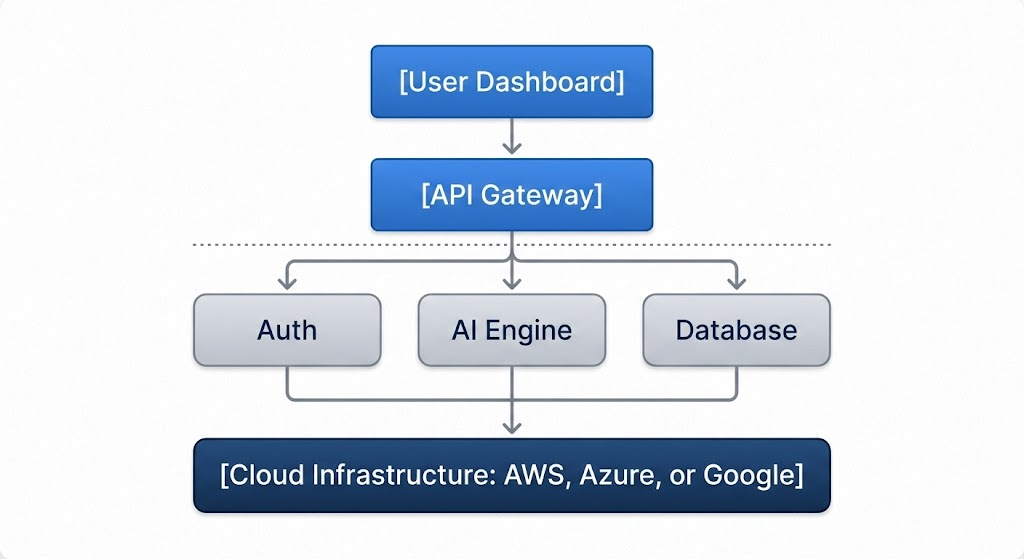
Every piece here has its own job. They stay connected through secure APIs to keep data moving safely. It’s complex, but that’s what makes it work.
Cloud Infrastructure
Amazon Web Services provides the heavy-duty computing power that keeps enterprise AI apps running. Microsoft Azure and Google Cloud do much the same thing. This kind of infrastructure helps businesses in real ways. Companies scale up fast when demand spikes. They save money on hardware. Backups get easier, and systems actually stay online. This flexibility lets AI startups support thousands of users at once.
AI Models:
An AI model is the heart of every SaaS platform. The specific tech depends on what a business actually needs to get done. Some tools lean on Generative AI, while others use Natural Language Processing to make sense of things. You might see Computer Vision or recommendation engines in the mix too. Predictive analytics is another common pick. Now, many companies are moving toward Agentic AI. It lets software agents tackle multi-step jobs. They just work, mostly on their own.
APIs and Integrations
Enterprise customers don’t want to rip out their current tech stacks just to make room for AI. They want software that plays nice with what’s already there. Modern SaaS platforms need to plug directly into CRMs, ERPs, and marketing tools without a struggle. It’s about making everything from HR software to customer support desks talk to each other.
A headless architecture helps with this. By pulling the frontend experience away from the backend logic, things stay flexible. This makes future updates much less of a headache.
Data Security and Compliance:
Big companies put security at the heart of every purchase. If an AI startup wants to win, it has to lock down data with end-to-end encryption. They use tools like role-based access and multi-factor authentication to keep the wrong people out. And they’re always watching. Constant monitoring, secure APIs, and regular audits are just part of the job.
It’s even tougher in healthcare or finance, though. These groups need to meet strict privacy rules and data standards. So, developers should bake safeguards right into the code from day one. It cuts business risk. More than that, it builds real trust.
Building AI Features That Solve Real Business Problems:
The best AI startups don’t just sell code. Instead, designers build these tools to fix the actual, messy problems people face at work.
| Industry | AI SaaS Use Case | Business Benefit |
| Restaurants | Demand forecasting | Reduce food waste |
| Hospitals | Patient scheduling | Improve resource utilisation |
| Dental Practices | Appointment reminders | Reduce missed appointments |
| Estate Agencies | Lead enrichment | Increase qualified enquiries |
Industry-specific tools often perform far better than generic software. They focus on delivering clear business outcomes rather than just providing technology for no reason.
How AI SaaS Is Monetized
Making a great AI SaaS tool is just the first step. To actually stay in business, you need a model that scales. This strategy draws in investors and keeps the lights on while you support big enterprise clients for years. Subscription models work best here. They tie what people pay to the value they get.
Subscription-Based Pricing:
Most people pay by the month or year. This keeps costs steady. You get the software, plus they handle the updates and security patches. And if things break, support’s there to help.
Typical subscription tiers include:
| Plan | Best For | Features |
| Starter | Small businesses | Basic AI automation |
| Professional | Growing companies | Advanced workflows and integrations |
| Enterprise | Large organisations | Custom AI models, security controls, dedicated support |
This model creates predictable revenue and helps companies measure growth through metrics such as:
Monthly Recurring Revenue (MRR)
Annual Recurring Revenue (ARR)
Customer Lifetime Value (LTV)
Customer Acquisition Cost (CAC)
Usage-Based Pricing
Some AI SaaS platforms charge based on consumption.
Examples include:
Number of AI requests
Amount of processed data
Number of automated tasks
API usage
Generated content volume
This works. Running AI gets pricey as you use it more, so companies pay for the value they’re actually getting. But keep pricing clear. A surprise bill is the fastest way to lose trust.
Outcome-Based Economics
AI SaaS is shifting toward outcome-based economics. Soon, pricing might tie directly to measurable results. Companies won’t just pay for a seat or a login anymore. That’s a massive change.
Get paid for every lead you find. You’ll also get paid when appointments stick and earn for each document processed or for the revenue you influence.
Instead of just another software bill, this approach makes AI a concrete investment that pays.
AI SaaS Growth Strategy: From Product to Platform
Many AI SaaS companies begin with a focused solution and later expand into broader platforms.
A narrow product might solve one problem:
AI appointment booking
Automated customer support
Lead generation
Over time, it can evolve into a complete business operating system.
This shift is often described as moving from point solutions vs. core platforms.
Point Solutions vs. Core Platforms
| Point Solution | Core Platform |
| Solves one problem | Connects multiple workflows |
| Limited integrations | Enterprise ecosystem |
| Smaller customer value | Higher lifetime value |
| Faster initial adoption | Stronger long-term retention |
Businesses increasingly prefer platforms because they reduce the number of disconnected tools they manage.
Scaling AI SaaS for Enterprise Growth
[Growing an AI SaaS startup isn’t just about hunting for new users. Your tech has to keep up with the sales. Operations need to scale too. And the user experience? That needs work.]
Scalable AI Architecture
Enterprise AI platforms commonly use:
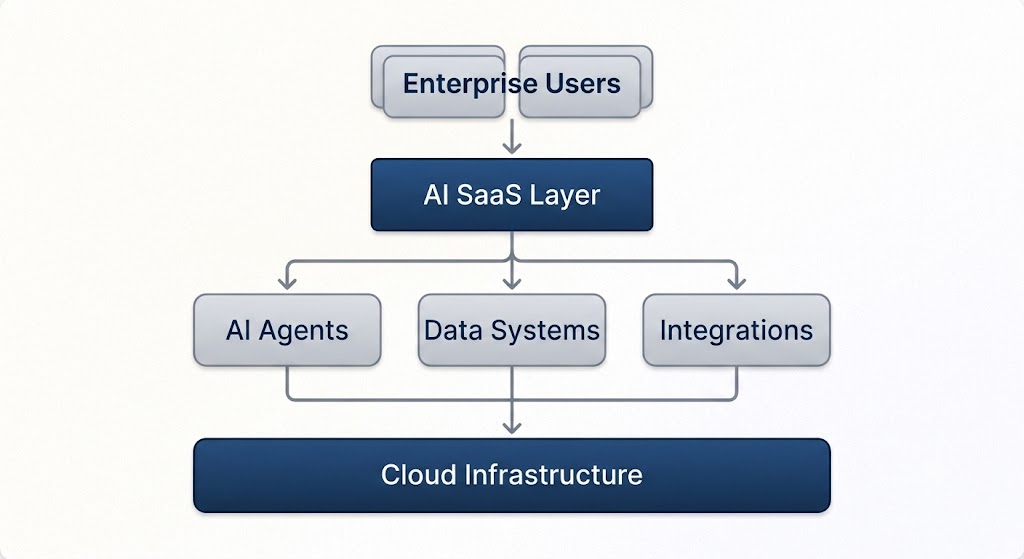
This structure allows companies to add customers without rebuilding the entire system.
Agent Orchestration and Autonomous Workflows
Modern SaaS products now lean on agentic AI and orchestration. Instead of one system grinding through a single task, a group of agents works together. It’s like a real estate office. One agent hunts for prospects. Another digs into lead data to fill in the gaps. A third agent ranks the best opportunities so no time is wasted. Then, a conversational bot talks to the buyers. These tools build an automated sales loop that actually flows.
AI SaaS Metrics That Matter
SaaS companies that actually make it keep a sharp eye on a few specific numbers.
Total Addressable Market (TAM)
Take Total Addressable Market, or TAM. It’s essentially the biggest slice of revenue a business could grab if it owned the whole room. Investors look at a massive TAM to see if a company can truly scale, and it’s how teams plan their next moves. Still, it’s just a starting point.
Customer Acquisition Cost (CAC)
Customer Acquisition Cost (CAC) reveals what a business spends to win a single customer. Typically, lower costs signal that sales and marketing efforts are genuinely effective. CAC shows the price a company pays to land a single customer. When that number drops, your marketing’s finally hitting its stride.
Customer Lifetime Value (LTV)
LTV tracks the money a customer brings in over the years. Good AI SaaS companies want that number high. Big enterprise clients are great for this; they stick around for ages.
Rule of 60
Software companies usually live or die by the Rule of 40. It’s a simple math trick where your growth rate and profit margin have to hit forty percent. But AI startups are different. They’re using automation to run so lean that forty feels low. Now, many are aiming for a Rule of 60
AI SaaS Applications Across Industries
Restaurants
Kitchen owners are turning to AI software to guess how many burgers they’ll flip next Tuesday. It helps them track inventory and tailor menus to what people actually want to eat, rather than just guessing. They’re also letting bots handle those “we miss you” marketing emails. It cuts down on the chaos. Less food ends up in the bin when the data tells you exactly how much steak to order.
Healthcare and Hospitals
Hospitals are in on it too. They use these tools to fix messy appointment schedules and smooth out the way staff talk to patients. It’s mostly about clearing the paperwork mountain. If a nurse doesn’t have to manually log every single data point, they can actually look a patient in the eye. That matters.
Dental Practices
Dentists use automated pings to remind you about that root canal. They’ve got chat assistants and follow-up systems that keep people coming back. It keeps the waiting room full and stops people from forgetting their slots.
Estate Agencies
Even estate agents are leaning on tech to find their next lead. They use smart filters to weed out the window shoppers from the actual buyers. It’s about working faster.
Opportunities land in your inbox every morning, like clockwork. This shift lets the small shops finally go toe-to-toe with the giants. It’s about speed, sure, but it’s also about making things feel personal again.
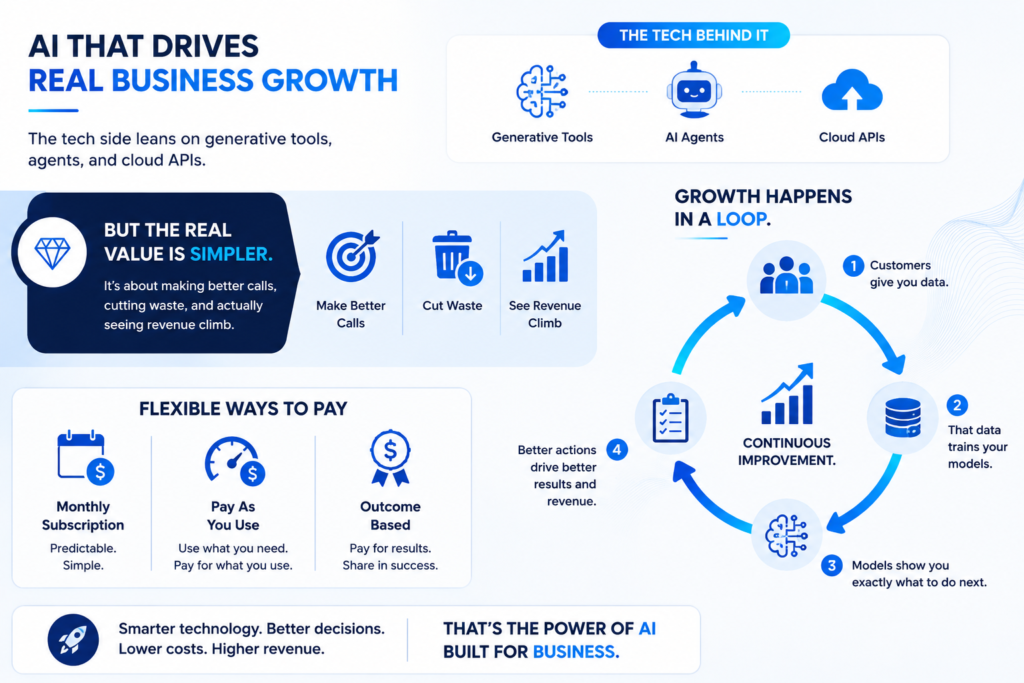
AI SaaS Infographic
People Also Ask
What is AI SaaS?
AI SaaS is cloud software that uses AI to handle the grunt work. It chews through data to fix messy business workflows. Most companies buy it because building an in-house AI rig is expensive; it’s just easier.
How does AI SaaS make money?
Most AI software companies make money through monthly subscriptions. They also bill by usage. But some firms prefer big enterprise contracts or even outcome-based pricing.
Is AI SaaS useful for small businesses?
Small shops are using AI software to handle customer chats or automate their marketing and calendars. It’s a way to boost sales and keep things running smoothly. But the best part? Owners don’t need a huge tech team to make it work.
What is the future of AI SaaS?
AI SaaS is shifting toward autonomous workflows. It’s about agents and personal touches now. Software finally has to show it can actually get work done.
Conclusion
AI SaaS changes how companies actually use artificial intelligence. You don’t need a massive tech budget anymore just to get a taste of advanced automation. Small teams can now grab the same intelligent decision-making tools that used to cost a fortune. It’s a huge shift.
The best platforms are on solid infrastructure and keep your data locked down tight. They offer practical features and pricing that actually makes sense for a growing business. But it’s about more than just buying software. Leaders have to pick tools that show real gains in productivity and help customers, rather than just chasing a trend.